Services

The Very Best Geothermal Heat Exchangers Down Under
Geothermal doesn’t work. At least, not always. The American Society of Heating and Air-Conditioning Engineers (ASHRAE), founded in 1894 and consisting of over 50,000 members from 132 nations, is a global society that is universally accepted amongst heating, ventilation, and air-conditioning (HVAC) engineers worldwide as being the ultimate source of truth when it comes to HVAC best-practices.
In their book, “Ground-Source Heat Pumps: Design of Geothermal Systems for Commercial and Institutional Buildings”, they note that one of the few – but major – disadvantages of geothermal is that, “Too often individuals assume that since the system is ‘geothermal’ it has to be better. Inexperienced individuals specify high-cost equipment above and expect it to operate at rated performance regardless of the ground loop design and installation quality.”
“Much of the team at CWL Group have been designing and constructing geothermal exchange systems for nearly two decades. CWL Group has not only more design and construct experience than any other organisation in the country, but likely more than all others combined. “
Over this period of time, we have continually evolved our ground heat exchanger designs and installations, researched and utilised the highest-performing cutting-edge products, and honed our installation methods to ensure that our geothermal exchange ground heat exchangers are the very best Down Under.
Optimised Computer Modelled Designs
“What’s the ‘rule of thumb’ in terms of how many boreholes I need?”
If only we had a gold coin for every time we were asked this question by an end-user, architect, developer, or even engineer. Our response?
“Thumbing it” with a vertical ground heat exchanger is a surefire way to end up with sweaty palms and lukewarm results. Using rules of thumb for such an intricate system is like attempting to sculpt a masterpiece with a sledgehammer; you may hit the mark occasionally, but the finesse required for absolute success will elude you. Harnessing the earth’s energy efficiently, sustainably, and cost-effectively requires meticulous calculation, not mere approximation.
Accordingly, CWL Group utilise specialised geothermal-exchange-specific software to model each and every ground heat exchanger we design and construct; from small residential projects requiring just two-or-three sub-100m boreholes, to aged-care centres, hospitals, hotels, urban skyscrapers and community district systems that necessitate dozens – to hundreds – of bores at 300m deep or beyond.
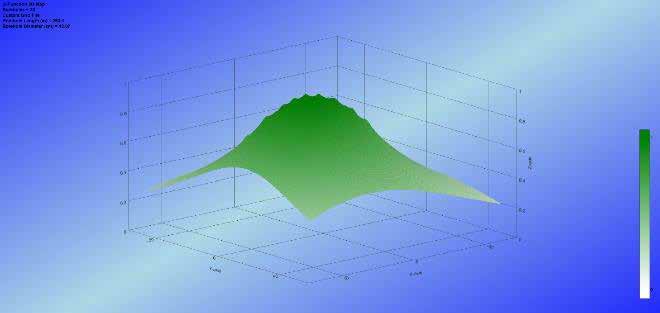
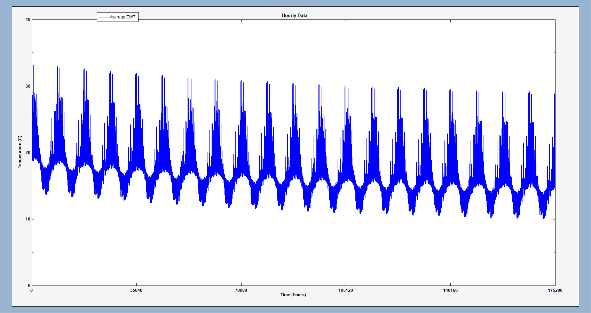
Moreover, because imbalances in a building’s heating and cooling loads can yield localised thermal saturation or thermal depletion of the Earth around the bore field, CWL Group simulates ground heat exchanger performance over decades to ensure that the significant capital investment in a geothermal exchange ground heat exchanger yields dividends for centuries into the future.
TurboCollector 45mm Pipework
Whereas our competitors utilise standard, internally smooth 32mm and 40mm pipework within the geothermal exchange borehole, CWL Group utilise Swedish-manufactured MuoviTech TurboCollector pipe. Typically, 45mm pipe is utilised on all but the smallest of CWL Group’s designed and constructed vertical ground heat exchangers.
Deeper boreholes, together with traditional 32mm and 40mm diameter pipe-loops, create too much of a pressure drop. Larger 45mm diameter pipework will typically reduce the amount of energy required to pump fluid through the boreholes by approximately 43% in comparison to 40mm pipework, and in the region of 80% compared to 32mm pipework.
However, the risk of larger pipework is that turbulent flow – which is crucial for efficient heat transfer – will not be achieved.
The images below illustrate the effect of turbulent flow on heat transfer within a geothermal loop. The image on the right shows laminar (non-turbulent) flow. The liquid next to the pipe-wall forms an almost-stationary layer that has an insulating effect. Hot goes to cold, but as the boundary layer inside the pipe and the earth around the pipe are both the same temperature (as indicated by them both being the same colour – red), there is no heat transfer occurring at this point.
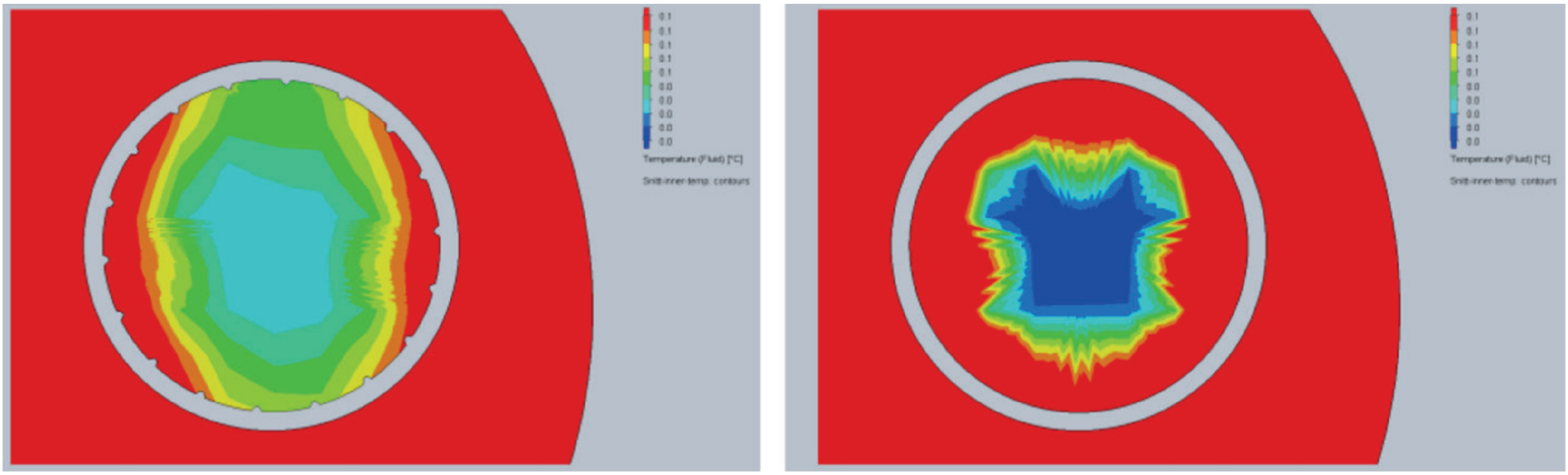
Conversely, the image on the left demonstrates turbulent flow. As the temperature of the fluid is more evenly mixed within the pipework, the temperature at the inner pipe-wall (green) differentiates significantly with that of the surrounding Earth (red), providing much better heat exchange per meter of drilled borehole.
So how does CWL Group promote turbulent flow within the pipework? TurboCollector.
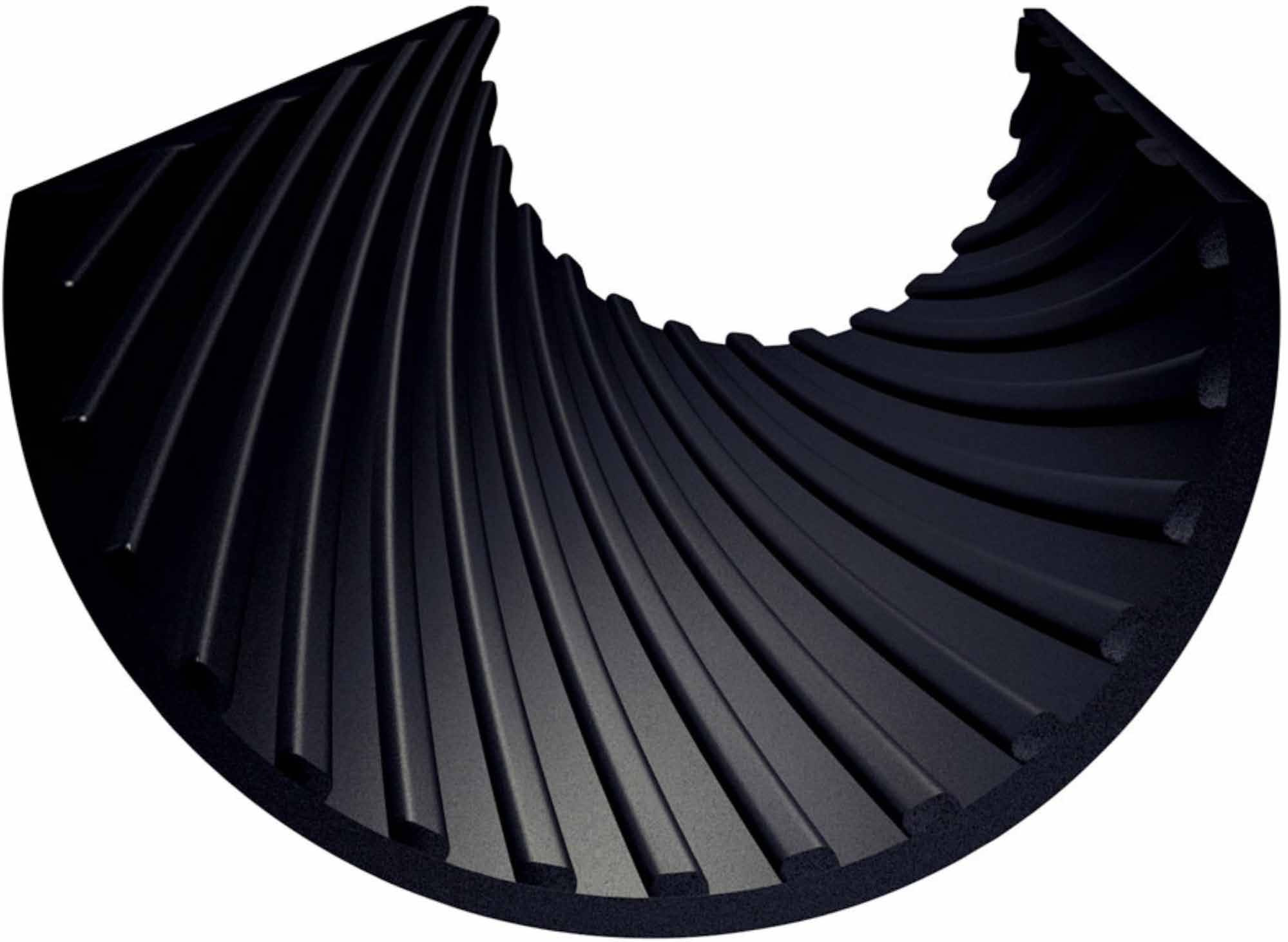
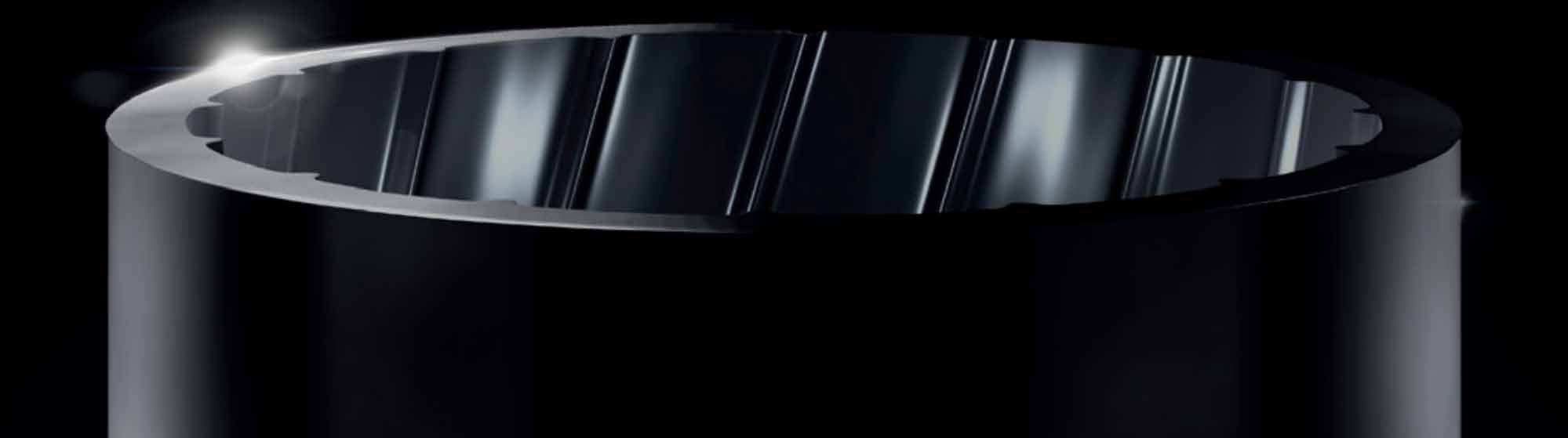
The secret of the TurboCollector is the internal ribbing, which creates turbulent flow at lower flow rates; particularly critical for today’s modern variable-speed circulators, heat pumps, and chillers. Field measurements show that TurboCollector loops have up to 33% better performance than equivalent standard loops, thus again demonstrating that, as not all boreholes are created equal, the quantity and depth of boreholes is not a reliable indicator of a loop field’s performance or capability.